
We hear where everyone is coming from with the lack of the HF and VHF bands. Let me take some time to explain a little bit about why that is the case.
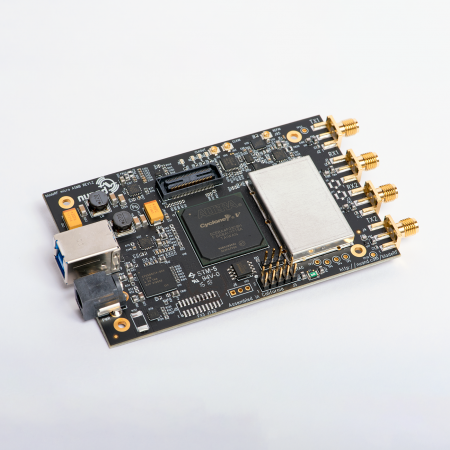
The main RF transceiver, the LimeMicro LMS6002D which makes all of this possible, is designed for wide bandwidth communication – specifically 1.5MHz to 28MHz bandwidths. For lower frequencies, especially in the VHF or HF band, this poses a problem for radios that are meant to be sensitive to adjacent channels since the typical bandwidth in that area is anywhere from 3kHz to 25kHz. Simply put, around 60 channels can fit within the smallest filter bandwidth of 1.5MHz.
For LimeMicro, it didn’t make sense to manufacture the device to cover the lower frequency bands since the adjacent channel rejection wouldn’t be very good. Moreover, getting a 1.5MHz allocation in VHF is near impossible.
So, while the bladeRF natively supports 300MHz to 3.8GHz, there are options available for HF and VHF reception.
First, the LMS6002D brings the analog ADC/DAC pins out and are available to connect to any 50Ohm source. This means that a bladeRF can act as a direct conduit to a 40MHz ADC or DAC. There is no need to use the LNA’s or mixers in the RF transceiver if you don’t want to use them.
Furthermore, we are working on designing an up/down converter to bring 50MHz – 300MHz up to the native tuning frequency of the bladeRF. When the design is completed, we’ll present it to the community in the form of an expansion board. One of the biggest issues with working in the VHF band is the massive number of FM radio stations located very close to people who are trying to listen to signals which can extend down to -120dBm or lower. With wide bandwidth comes the potential to listen to wide noise! We need to be careful to not saturate our front ends with bogus signals and provide a terrible radio experience.
We are excited and extremely grateful for all the support and positive comments we’ve seen from this kickstarter campaign. We want to try to make this as accessible to everyone as possible, so, as always, comments and suggestions are welcome.


Recent Comments